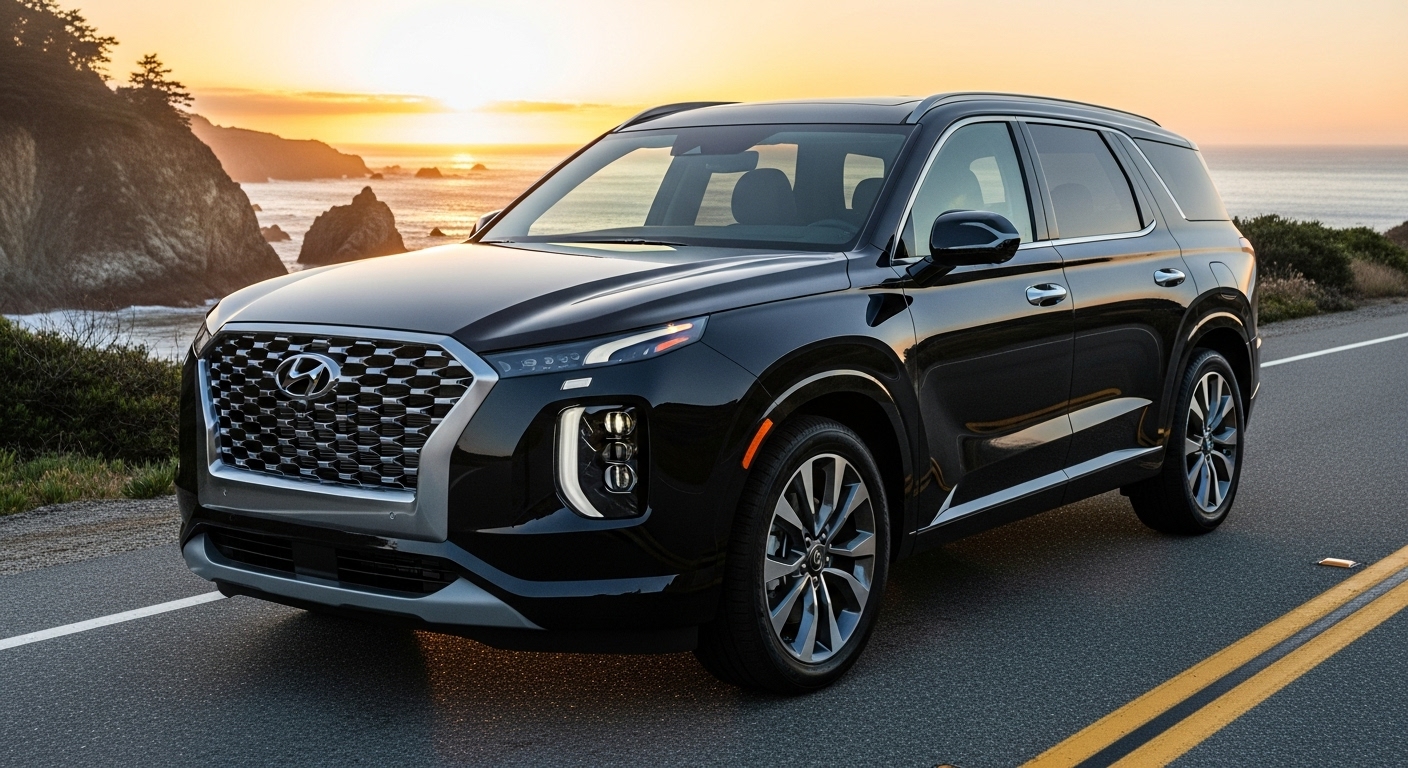
The SUV game in India is heating up, and Hyundai appears ready to make a bold statement with the 2025 Hyundai Palisade. Positioned as a premium seven-seater flagship, the Palisade 2025 is expected to challenge segment stalwarts like the Honda CR-V (especially in its higher, three-row variants) by offering luxury touches, advanced safety tech, and strong presence.
With rumored pricing of around ₹40 to ₹45 lakh (ex-showroom) and a host of features including panoramic sunroof, ADAS systems, and three-row flexibility, the Palisade is poised to claim a distinct space in India’s SUV hierarchy.
In this article, we take a deep dive into everything we know (and expect) about the Hyundai Palisade 2025 — from its potential specifications, cabin features, competitive positioning, safety features, pricing, EMI scenarios, and market prospects.
1. Why the Palisade Matters for India’s SUV Landscape
While India has many popular SUVs, few reach into the flagship, premium, three-row, luxury-oriented territory. Hyundai’s intention with the Palisade likely is to move beyond the compact and mid-size SUV segments—and offer an Indian buyer a global-level flagship.
Consumers who compare “Honda CR-V 2025” often expect solid build, premium features, comfort, and reliability. The Palisade seeks to outperform such expectations by delivering:
- Greater space and comfort for seven occupants
- More premium interior appointments
- Advanced safety and driver-assistance systems (ADAS)
- Strong road presence and styling befitting a flagship
Thus, the Palisade is not just a bigger SUV — it’s a statement of Hyundai’s ambition in India.
2. Expected Specifications & Powertrain
While Hyundai has not officially confirmed all specs for the Indian Palisade 2025, industry sources and global versions provide a foundation for expectations.
Powertrain Options
Globally, the Palisade has been offered with powerful engines. For India, plausible configurations include:
- V6 / 3.5L or 3.8L petrol engine: Producing around 287 bhp and torque in the ~320–350 Nm range. (Edmunds)
- Diesel / Turbocharged option (less likely in the long run, given shifting trends)
- 8-speed automatic transmission as the standard or preferred gearbox, with options for all-wheel drive (AWD) or front-wheel drive (FWD) variants. (Wikipedia)
These configurations suggest performance oriented toward refined highway cruising, with sufficient torque for loaded driving and Indian road conditions.
Dimensions & Capacity
As a full-size flagship SUV, the 2025 Palisade is expected to deliver:
- A lengthy wheelbase and extended rear overhang to ensure third-row usability
- A high ground clearance, AWD options, and robust suspension suited for India
- Ample cargo space even with all three rows in use
Global versions already present as a true full-size SUV, and the Indian version is likely to closely mirror those proportions. (Wikipedia)
3. Exterior & Styling Upgrades
The Palisade 2025 facelift introduces fresh design cues that align with Hyundai’s evolving design philosophy. Expect:
- Parametric grille with sharper LED DRL signature
- Slim, vertical LED headlights merged within grille architecture
- Bold character lines along the body — more muscular and modern
- Connected taillight bar across the rear for a distinctive look
- Panoramic glass roof / sunroof (especially in premium trims)
- Larger wheels (19–20 inches) with aerodynamic designs
- Strong use of chrome or gloss black trim to accent the flagship feel
The appearance will aim to be assertive and upscale, visually signaling the Palisade as a step above Hyundai’s usual SUV range.
4. Interior, Comfort & Features
This is where the Palisade will aim to justify its premium positioning. Some expected highlights:
Cabin Layout & Seating
- Seven-seat layout, with flexible folding for second and third rows
- Option for captain seats in the second row in higher trims
- Improved legroom and headroom in all rows, especially the third
- High-quality materials: ambient lighting, premium leather or leatherette, soft-touch surfaces
- Noise insulation and comfort tuning to damp road noise
Technology & Infotainment
- Dual 12.3-inch displays: one for instrument cluster, another for infotainment (global versions use such). (Wikipedia)
- High-end audio system with multi-zone control
- Panoramic sunroof extending over front and rear rows
- Wireless charging and multiple USB-C / fast charging ports
- Over-the-air (OTA) software updates, connected vehicle features & smartphone integration
- Voice commands, smart assistants, ambient lighting customization
The interior aims to provide a luxury, tech-forward experience that rivals international premium SUVs.
5. Safety & ADAS Features
As a flagship, safety and advanced driver assistance must be top-tier. Expected inclusions:
- 6–8 airbags across all seating positions
- Forward Collision Warning / Automatic Emergency Braking
- Lane Keep Assist, Lane Departure Warning
- Adaptive Cruise Control
- Blind-spot monitoring, Rear Cross-Traffic Alert
- 360-degree camera with parking assist
- Electronic Stability Control, Traction Control
- Hill-start, hill-descent control
- Strong chassis with crash safety engineering & high-strength steel
The Palisade will likely target top safety ratings in global crash tests to assure Indian buyers of its structural integrity.
6. Mileage, Efficiency & Trade-Offs
One challenge for large SUVs is fuel efficiency. The Palisade’s engine and weight necessarily bring trade-offs.
In India, though, Hyundai may tune the powertrain for:
- Optimized gear ratios
- Cylinder deactivation in larger engines
- Mild hybrid systems (if adopted)
- Aerodynamic and rolling resistance improvements
Expected real-world mileage (petrol V6 / 3.5L class) would be in the range of 8–10 km/l, maybe a bit more in relaxed highway driving.
While not efficient by compact SUV standards, buyers of flagship SUVs often prioritize comfort, space, and presence — making the trade-off acceptable.
7. Pricing & EMI Estimates
Given import duties, local assembly, and Hyundai’s brand positioning, rumored pricing for the Palisade in India falls in the ₹40–₹45 lakh (ex-showroom) range. (CARS24)
Some media sources already list its expected price starting at ₹40 lakh. (CarDekho)
EMI Scenario
For example, if one opts for a ₹35 lakh financed amount (after down payment) at 9% interest over 5 years, the likely monthly EMI would be in the ballpark of ₹45,000–₹50,000 depending on variant and down payment.
These numbers place the Palisade solidly in premium territory — but still potentially accessible to aspirational buyers who want three-row luxury.
8. Comparison with Honda CR-V & Segment Positioning
Many shoppers comparing “Hyundai Palisade 2025” also look at SUVs like the Honda CR-V. While the CR-V is more oriented toward compact / mid-size SUV buyers, the Palisade offers:
- More seating capacity (7 vs. 5 in CR-V)
- Larger dimensions, more comfort, more features
- Stronger presence and luxury positioning
- Advanced technology and optional AWD
- Trade-off in fuel economy, cost, and parking size
Thus, the Palisade competes more with flagship three-row SUVs or premium global imports than with standard mid-size rivals. Its positioning is aspirational.
9. Launch Timeline & Market Strategy
Industry watchers speculate that Hyundai may launch the Palisade in India in late 2025 or early 2026. Local assembly (to reduce import cost) would help keep prices competitive.
Hyundai could roll it out initially in major metros — Delhi, Mumbai, Bangalore — and slowly expand based on demand. Early bookings, limited editions, and VIP allocations may accompany its launch.
Hyundai might also align the Palisade launch around auto expos to generate media attention and positioning as a flagship aspirational product.
10. Prospects & Challenges
Strengths
- Flagship appeal in branding and features
- Seven-seater luxury option in Hyundai’s lineup
- Strong global pedigree and advanced features
- Helps Hyundai capture premium customers who may otherwise buy imported SUVs
Challenges
- High import/duty costs if not sufficiently localized
- Running costs: fuel, maintenance, servicing
- Parking and size constraints for Indian urban buyers
- Convincing buyers to choose it over more-established luxury competitor SUVs
Success will depend on striking the right balance between premium features, cost efficiency, and local relevance.
Conclusion
The Hyundai Palisade 2025 is shaping up to be Hyundai’s most ambitious SUV yet in India. With its seven-seat capability, premium materials, ADAS features, sunroof, and powerful engine options, it aims to appeal to buyers looking for a flagship experience.
Priced in the ₹40–₹45 lakh range and with expected EMIs of ₹45,000–₹50,000, the Palisade is not meant for mass-market buyers — it’s for those who want to make a statement. In that sense, it positions itself above typical comparisons like the Honda CR-V and into a rarified premium segment.
If Hyundai delivers reliable after-sales, service penetration, and justifies the cost through longevity and features, the Palisade 2025 could become one of the most desirable three-row SUVs in India.