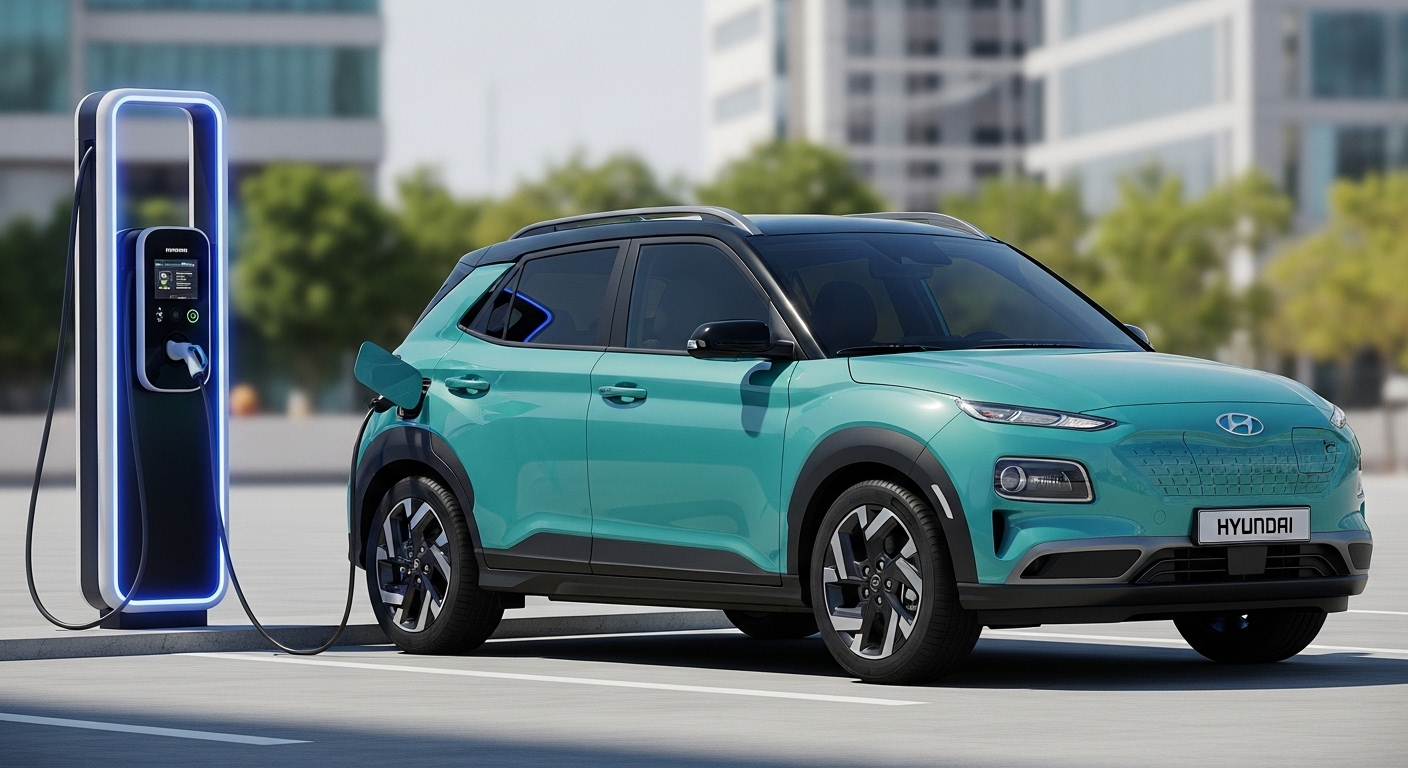
India’s electric vehicle market is rapidly expanding — and Hyundai is preparing to make its next bold move. After the success of the IONIQ 5 and Kona Electric, the automaker is now working on a compact, city-friendly, all-electric SUV aimed at the mass market.
Tentatively called the Hyundai Micro Electric SUV 2025, this new model will mark Hyundai’s most affordable EV in India, targeting first-time electric buyers, city commuters, and environmentally conscious families. With an expected price of around ₹9 lakh, range near 250 km, and fast-charging capability, the Micro EV could completely redefine budget-friendly electric mobility in India.
Let’s explore in detail what to expect from this upcoming Hyundai Micro Electric SUV — including its design, performance, battery, safety features, and estimated EMI details.
⚡ 1. Hyundai’s Electric Revolution for the Mass Market
Hyundai has established itself as a trusted brand in India’s EV space with the Kona Electric and the futuristic IONIQ 5, both delivering impressive performance and technology. However, these models cater to the premium segment, priced above ₹20 lakh.
The new Hyundai Micro Electric SUV (2025) aims to change that by offering EV technology at an affordable price point. It’s being designed primarily for urban and semi-urban users who need compact dimensions, low running costs, and easy charging options.
This will be Hyundai’s entry-level EV, competing directly with models like the Tata Tiago EV, MG Comet EV, and the upcoming Maruti Suzuki eWX. Hyundai’s goal is clear — to make electric mobility accessible to the masses.
🚙 2. Exterior Design — Compact, Stylish, and Futuristic
Even though it’s positioned as a budget EV, the Hyundai Micro Electric SUV is expected to carry the brand’s signature styling and futuristic design language.
Expected Exterior Highlights:
- Compact SUV stance with strong body lines and raised ground clearance.
- LED daytime running lights (DRLs) integrated into a sleek closed-off front grille for better aerodynamics.
- Projector LED headlamps positioned on the bumper.
- Chunky wheel arches with 14–15-inch alloy wheels for a sporty look.
- Contrasting roof design with integrated roof rails.
- LED taillight bar connecting both ends for a modern rear profile.
- Minimalistic Hyundai badging and blue EV accents on bumpers and sides.
Despite its small size, the Micro EV is expected to look modern, bold, and premium — making it an attractive choice for city buyers who want both style and sustainability.
🏠 3. Interior and Comfort — Smart, Minimal, and Practical
Hyundai is known for packing its vehicles with features, and the Micro Electric SUV is no exception. Even at its price point, the brand aims to deliver a modern, tech-inspired cabin experience.
Interior Highlights:
- Dual-tone dashboard with soft-touch finishes.
- Digital instrument cluster showing range, battery level, and energy consumption.
- Touchscreen infotainment system (7–8 inches) with Android Auto and Apple CarPlay.
- Automatic climate control and rear AC vents.
- Premium fabric upholstery with contrast stitching.
- Flat-bottom steering wheel with mounted controls.
- Wireless charger and multiple USB-C ports.
- Foldable rear seats for added storage flexibility.
The focus will be on space optimization and ease of use, ensuring the Micro EV feels roomy despite its compact footprint.
⚙️ 4. Powertrain and Performance
While Hyundai has not officially confirmed specifications, reports suggest the Micro Electric SUV will feature a single electric motor setup with front-wheel drive (FWD).
Expected Powertrain Specs:
- Battery Capacity: 25–30 kWh (lithium-ion)
- Power Output: 45–60 bhp
- Torque: 100–120 Nm
- Transmission: Single-speed automatic
- Drivetrain: Front-wheel drive
This setup is tuned for city driving efficiency rather than outright speed. With instant torque, it should offer brisk acceleration and smooth operation — ideal for daily commutes and short weekend trips.
🔋 5. Battery, Range, and Fast Charging
One of the key selling points of the Hyundai Micro EV will be its range and charging flexibility.
Expected Battery & Range Details:
- Range (ARAI): 230–250 km per full charge.
- Home Charging: 0–100% in 8–9 hours (using a 15A socket).
- Fast Charging: 10–80% in just 50–55 minutes (using a 30–50 kW DC charger).
- Regenerative braking to recover energy while slowing down.
This makes the Micro EV perfect for daily commutes up to 40–50 km, with enough reserve for unplanned trips.
By supporting both AC and DC charging, Hyundai ensures that users can charge conveniently at home or on public networks.
🧠 6. Safety and Build Quality — 5-Star Assurance
Hyundai is known for its solid build quality and safety-first approach, and the Micro Electric SUV will be no exception. Even as an entry-level EV, the company plans to equip it with a strong list of safety features.
Expected Safety Features:
- 5-star Global NCAP safety rating target.
- Dual airbags (standard) and optional side airbags in higher trims.
- ABS with EBD and Brake Assist.
- Electronic Stability Control (ESC).
- Rear parking sensors and reverse camera.
- Hill-hold assist (for automatic variants).
- Tire pressure monitoring system (TPMS).
- Seatbelt reminder and ISOFIX child seat mounts.
The Micro EV will likely use Hyundai’s proven K1 platform (heavily modified for EVs), which has already performed well in crash tests globally.
💡 7. Technology and Infotainment
For tech-savvy users, Hyundai plans to make the Micro EV feature-rich and connected.
Tech Highlights:
- Touchscreen infotainment system with Hyundai’s BlueLink connectivity suite.
- Voice-controlled functions for AC, music, and calls.
- Smart keyless entry and push-button start.
- Remote climate control via smartphone app.
- Driving mode selector: Eco, Normal, and Sport.
- Digital driver display showing live range and regenerative braking intensity.
These features ensure that even though it’s Hyundai’s smallest EV, the Micro SUV still feels advanced and future-ready.
🌱 8. Sustainability and Cost Efficiency
Beyond zero emissions, the Micro Electric SUV also focuses on sustainable materials and low running costs.
- Expected running cost: ₹1–₹1.5 per km, compared to ₹6–₹8 for petrol cars.
- Recycled interior plastics and eco-friendly seat fabrics.
- Lower maintenance due to fewer moving parts (no engine oil, clutch, or exhaust system).
For urban families and daily commuters, this means massive long-term savings without compromising convenience.
💰 9. Price, Variants, and EMI Details
The Hyundai Micro Electric SUV will be the most affordable EV in Hyundai’s lineup. It’s expected to launch in two to three variants, catering to different budgets and features.
Expected Price (Ex-Showroom, India):
- Base Variant: ₹8.9 lakh
- Mid Variant: ₹9.5 lakh
- Top Variant: ₹10.2 lakh
This pricing puts it directly against Tata Tiago EV and MG Comet EV, both popular city EVs.
Estimated EMI Plans:
If you take a car loan of ₹8 lakh at 9% interest for 5 years, your EMI will be approximately ₹16,000 per month.
This makes EV ownership accessible for middle-class families, young professionals, and small business owners looking for an economical urban car.
📅 10. Launch Timeline and Availability
Industry insiders suggest that Hyundai could unveil the Micro Electric SUV in mid-2025, with sales beginning by late 2025 or early 2026.
The SUV will likely debut first in major cities like Delhi, Mumbai, Bengaluru, Chennai, and Hyderabad, followed by smaller towns with expanding EV infrastructure.
Hyundai is expected to localize battery pack assembly and components to reduce costs and ensure competitive pricing. The company could even collaborate with Indian suppliers for charging equipment and software support.
🏁 11. Rivals and Market Competition
The Hyundai Micro Electric SUV will enter a fast-growing segment with multiple strong competitors.
Key Rivals:
- Tata Tiago EV – ₹8.7–₹12 lakh, 250–310 km range.
- MG Comet EV – ₹7.98–₹9.98 lakh, 230 km range.
- Maruti Suzuki eWX – upcoming model, expected 250 km range.
- Citroën eC3 – slightly above ₹11 lakh range, 29.2 kWh battery.
With Hyundai’s design strength, global EV experience, and reliability, the Micro EV could emerge as the most complete package in this segment.
🌟 12. Why the Hyundai Micro Electric SUV Stands Out
Here’s why this compact Hyundai EV might redefine electric commuting in India:
- Affordable price tag under ₹10 lakh — accessible for mass buyers.
- 250 km real-world range — enough for weekly city commutes.
- Fast-charging support — 80% charge in under 1 hour.
- 5-star safety assurance and reliable Hyundai engineering.
- Feature-rich interior with connected tech and infotainment.
- Low running and maintenance cost — perfect for daily use.
Hyundai is combining affordability, practicality, and advanced tech — something Indian EV buyers have been waiting for.
Conclusion
The Hyundai Micro Electric SUV 2025 could be a turning point for India’s EV market. By bringing electric mobility within reach of everyday buyers, Hyundai is aiming to democratize clean mobility in the same way it once made hatchbacks mainstream.
With a range of around 250 km, fast-charging support, 5-star safety features, and an expected price of ₹9 lakh (EMI around ₹16,000), this Micro SUV blends futuristic technology with affordability.
For city dwellers, first-time EV users, or anyone seeking a budget-friendly electric car that doesn’t compromise on features or safety — the Hyundai Micro Electric SUV looks set to be a game-changer. ⚡🚗